The optimisation trap: When self-improvement becomes self-surveillance
In recent years, the culture of self-improvement has acquired the authority of common sense, sustained by a vast ecosystem of podcasts, productivity frameworks, and the seductive mathematics of marginal gains, the idea that the self is a system that can be optimised, one habit at a time, until life becomes frictionless and efficient.
For the high-performing professional, this logic feels immediately familiar, as their careers are already organised around strategic thinking, measurement, and incremental improvement, making it only a small step for the same logic to migrate inward and transform personal life into something that can be engineered with equal precision.
Yet optimisation is rarely a neutral tool, and for the ambitious mind it has a tendency to expand until the individual is no longer inhabiting their life, but monitoring and refining it.
The colonisation of the private self
Optimisation has a tendency to extend into every available corner of a person’s existence, often beginning innocently with a refined morning routine or a more disciplined approach to deep work, before the logic of return on investment begins to shape areas of life that were once guided by curiosity, pleasure, or instinct.
Diet becomes a domain of bio-hacking, reading is curated for intellectual return, exercise is tracked and adjusted, and even sleep, once a simple biological surrender, becomes something to be monitored, scored, and evaluated.
Gradually, the question that once guided the inner life, what would I like to do, is replaced by a more instrumental alternative, what would be most effective. At that point, something significant has shifted, as life is no longer experienced primarily as something to inhabit, but as something to observe, assess, and continuously improve.
When improvement becomes surveillance
For the perfectionist, the language of optimisation merges seamlessly with the inner critic, which rarely presents itself as harsh, instead adopting the tone of a helpful consultant suggesting that there is always a better system, that you are close, but not yet optimised.
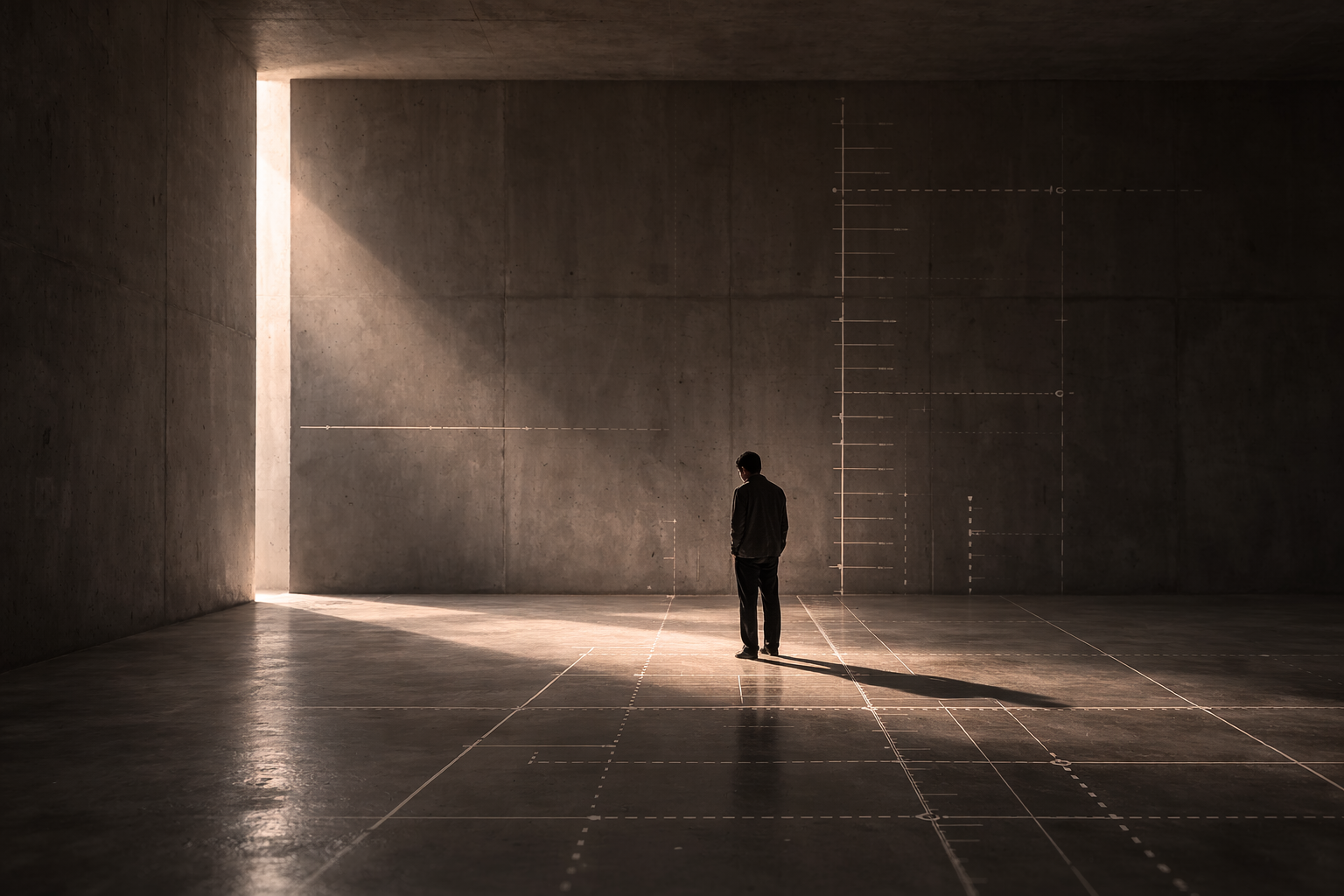
This is the point at which improvement becomes surveillance, as the individual becomes both the subject of the experiment and the observer with the stopwatch, watching themselves from a distance, scanning for inefficiencies, and treating their own personality as something to be refined.
The question is no longer how you are, but how you are performing against your own expectations.
The boundary between guidance and monitoring begins to dissolve, and when life becomes a system to be perfected, the self is no longer encountered as a person, but as a project, one that, by definition, is never finished.
The anxiety of the infinite goalpost
Beneath this drive lies a more persistent pressure, the sense that there is always a better version of oneself just within reach, as the mind organises itself around this ideal and continuously adjusts behaviour in an attempt to close the gap.
The difficulty is that optimisation has no natural endpoint, as there is always another variable to refine and another inefficiency to address, meaning that the standard shifts as quickly as it is approached. This produces a form of ongoing dissatisfaction, not dramatic but continuous, a sense of being in motion without ever arriving. This can, over time, begin to resemble burnout, which you can read more about here.
The loss of unobserved experience
The highest cost of this orientation is not fatigue, but the loss of experiences that are not being evaluated while they occur. Psychological life requires moments that are not organised around improvement, where attention is not directed towards outcome and experience is allowed to unfold without being measured against a standard, as these are the conditions in which reflection, creativity, and emotional processing can take place.
When attention remains structured around optimisation, the internal landscape narrows and experience becomes filtered through usefulness, so that moments without a clear function begin to feel unnecessary or even wasteful. What is lost is not time, but a particular quality of attention, one that allows experience to be lived rather than assessed.
Living beyond the system
Ironically, the qualities that optimisation seeks to cultivate, clarity, resilience, and insight, tend to emerge most readily in conditions that resist measurement and belong to a different psychological rhythm, one that cannot be fully captured through systems or frameworks.
For the individual accustomed to structuring their life around improvement, stepping outside this logic can feel disorienting and may even register as a loss of direction, yet it is often in this shift, away from constant evaluation and towards direct experience, that something begins to loosen.
The relationship to the self becomes less instrumental and less governed by performance, allowing for greater variation and a more flexible engagement with experience. Psychological growth, in this sense, involves loosening the need to monitor and refine every aspect of life, and allowing parts of experience to remain unoptimised.
Not everything that matters can be improved, and some things can only be lived.
If this pattern feels familiar, you may recognise it in other areas of your life. I’m Fine, Just Tired explores the experience of continuing to function while feeling increasingly disconnected from vitality, and The High-Achiever in Love looks at how the same orientation towards control and optimisation shapes the experience of intimacy, often limiting the possibility of being fully met. You can read more about how this shows up in relationships here.
Dr Anne Li is a Chartered Counselling Psychologist with over fourteen years of clinical experience. She specialises in working with high-performing professionals, leaders, founders, and executives navigating burnout, perfectionism, relationships, identity, and life transitions.
If these reflections resonated, you can learn more about her approach to therapy here.